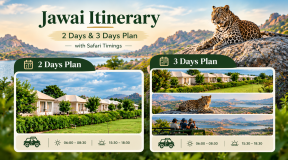
How many leopards in Jawai? Most estimates put the number somewhere between 50 and 70, and that is exactly why so many travellers plan a trip here. Ask anyone who has been, and they will tell you about a leopard sitting on a granite rock at sunrise, looking back at the jeep as if it owned the hill. It did, of course.”
That moment leads straight to the question almost every traveller asks before booking: how many leopards are actually out there?
That moment leads straight to the question almost every traveller asks before booking: how many leopards are there in Jawai, really? That number comes with a few important “ifs,” and understanding them will help you plan a better trip and set honest expectations. Let’s go through it properly..
The Quick Answer
Forest department figures and wildlife researchers generally estimate around 50 to 70 leopards living in and around the Jawai Bandh area in Pali district, Rajasthan. You will see slightly different figures on different websites. Some say 50 to 60, others say 60 to 70. Neither is wrong, because nobody is counting a fixed herd. These are wild, free-ranging cats that move across hills, caves and farmland, and they are not easy to count.
So if a resort tells you “exactly 63 leopards,” be a little careful. An honest answer is a range.
Where Exactly Do These Leopards Live?
Jawai sits in the Sumerpur tehsil of Pali district, between Udaipur and Jodhpur, at the edge of the Aravalli hills. The leopards are spread across the rocky granite hills that surround Jawai Dam, and across the villages and scrubland nearby.
The core protected area is the Jawai Bandh Leopard Conservation Reserve, notified on 23 February 2010. At notification, it covered roughly 19.79 square kilometres around the dam. That sounds small, and it is. But the leopards do not stay inside a neat boundary. They use the wider landscape, which is why researchers have studied a much larger area, running into hundreds of square kilometres, when trying to understand the population.
If you want to understand how the reserve was formed and why it is not a national park, our post on Jawai National Park explains it in simple terms. And for the story of the dam itself, read the history of Jawai Bandh.
Why Is It So Hard to Give an Exact Number?
This is the part most blogs skip, so it’s worth spending a minute on.
1. Leopards are solitary and secretive. A leopard spends much of its day resting in a cave or a crevice. Even in Jawai, where they are relaxed around people, a leopard you don’t see is still there.
2. They move. Males hold larger territories than females, and young leopards leave their mothers and look for new ground. Some animals cross in and out of the reserve area.
3. Counting methods differ. Researchers use camera traps, pugmark tracking and direct sightings. Each method gives a slightly different result, and the area counted also changes the answer.
4. The population changes. Cubs are born, older animals die, and a few move away. Any number is a snapshot, not a permanent record.
That is why a range, 50 to 70, is the most honest way to say it.
Why So Many Leopards in One Small Area?
Jawai is unusual, and the reasons are worth knowing. Leopards across India usually avoid people. Here, they have learned to live right beside them.
The hills are full of caves. The granite outcrops have natural caves, ledges and boulder stacks. These make perfect dens and safe places to raise cubs.
There is enough food. Jawai’s leopards eat ordinary things: stray dogs, feral pigs, porcupines, hares, birds and the occasional goat or calf. There is enough of this around to support a lot of cats in a small space.
There is water. Jawai Dam is the largest water body in the region. It draws prey animals, and it keeps the landscape greener than the surrounding dry country.
The local community lives alongside them. The Rabari shepherds have grazed their herds on these hills for generations. Many locals treat leopards with a kind of quiet respect, and there is a long tradition of coexistence here. That has helped the population stay stable. You can read more about village life in our Jawai village tour guide.
To be honest about it, coexistence does not mean there is never a problem. Wild leopards are still wild animals, and occasional incidents have been reported across the region. Good guides, calm behaviour and respect for the animals matter, which is why you should always follow your guide’s instructions on safari.
How Jawai Compares With Other Leopard Spots
Many people ask whether Jawai is better than other places to see leopards in Rajasthan, such as Jhalana in Jaipur. The honest answer is that they are different experiences.
Jhalana is a smaller forest reserve right next to a big city. Jawai is an open landscape, with rocky hills, a dam and villages around it. The leopards here are active in the open and are used to safari jeeps, so sightings can happen even in daylight.
If you are weighing leopards against tigers, our post on Jawai vs Ranthambore covers the differences in detail.
What Else Lives in Jawai Besides Leopards?
The leopards get all the attention, but Jawai has plenty more to offer, especially on the slower days of your trip.
- Mugger crocodiles live along the dam and the river. Jawai is known for having one of the largest populations in Rajasthan.
- Sloth bears are sometimes spotted on the hills, though less commonly.
- Striped hyenas, golden jackals and jungle cats are among the other predators here.
- Nilgai (blue bull) and Northern plains langurs are easy to see.
- Birds are a big draw. Around 85 species have been recorded around the dam and the hills, including many migratory birds in winter. If this interests you, read our guide to bird watching in Jawai.
So Will You Actually See a Leopard?
This is the question behind the question. And here is the straight answer: your chances in Jawai are better than in most places in India, but nobody can promise a sighting.
Think of it this way. Having 50 to 70 leopards in a compact landscape raises your odds a lot. The terrain is open and rocky, so you can scan the hills without thick forest blocking your view. And the guides know the leopards’ favourite rocks and caves.
But the leopard still decides. On some mornings, you will see two or three. On others, you might see none, and a patient morning of watching the hills will have to be enough.
We have written a whole post on this called Is a Leopard Sighting Guaranteed in Jawai?, and it is worth reading before you book, so that you plan with realistic expectations.
How to Improve Your Chances of Seeing a Leopard
You cannot control the animals, but you can control a few things that matter.
Do both safaris. Leopards are most active early in the morning and in the evening. The morning safari usually runs from around 5:30 AM to 8:30 AM, and the evening one from around 5:00 PM to 8:00 PM. Doing both gives you two separate chances. Check the full details in our Jawai leopard safari timings guide.
Stay at least two nights. One night means two safaris. Two nights means three or four. If the first outing misses, the second or third can make up for it. Our 2-day and 3-day Jawai itinerary shows how to plan this.
Choose the right season. Winter, from roughly November to February, is the most popular time. The weather is cool, the vegetation thins out, and visibility is better. Read the best time to see leopards in Jawai for a month-by-month view, or the winter Jawai leopard safari guide if you are travelling in the colder months.
Be quiet and patient. Talk softly, don’t stand up in the jeep, and keep your phone on silent. Leopards in Jawai are calm around vehicles, but loud noise can still send them back into the rocks.
Listen to your guide. Local guides track these animals daily. They often know which rock a particular leopard likes in the morning. Trust their pace.
Wear dull colours. Earthy greens, browns and greys work better than bright shades.
Bring a zoom lens or binoculars. Many sightings happen at a distance. If you carry a camera, our Jawai wildlife photography guide has practical tips.
If you are new to this, our post on 5 things to know before a leopard safari in Jawai is a useful quick read.
What Happens on a Safari at Agvani Resort?
When you stay at Agvani Resort, the safari and the stay are planned together, so you are not coordinating with a separate operator.
- You get an open gypsy for your own group, not shared with other guests. It takes up to six people (four on the full-day safari).
- A driver and a guide who know the area come with you.
- Tea and coffee are included on the drive.
- Pick-up and drop-off are taken care of.
Other safaris are also available, including village safaris, bird and crocodile sightings, a Jawai Dam visit and a full-day safari. You can see the full range on our Jawai safari page.
Not sure how many days to book? Our Jawai leopard safari packages guide lays out the options, or you can browse the tour packages page.
Planning a Leopard Safari in Jawai?
Book your stay and leopard safari together at Agvani Resort. Share your dates and group size with us.
Beyond the Leopards: Other Things Worth Doing
If your leopard count for the trip turns out to be low, Jawai still has plenty to fill your days. A walk through a Rabari village, a quiet morning at the dam, a nature walk across the hills and a bonfire in the evening can make the trip feel complete.
For more ideas, see things to do in Bera Jawai besides a safari. Travelling with children or parents? Our post on Jawai with kids is a good place to start.
Where to Stay for the Best Chance at a Sighting
Where you stay matters more than people think. A resort close to the safari zone means less travel time in the dark, an easier early wake-up and a smoother day.
Agvani Resort is set near Jawai Dam, with luxury tents, Rajasthani-style cottages and cottages with a plunge pool. Between safaris, you can use the pool, enjoy a meal at the resort restaurant, or sit by a bonfire in the evening. You can see the rooms on the resorts in Jawai page and check current rates on the tariff page.
Coming from out of town? The how to reach Jawai page, along with our guide to reaching Jawai from Udaipur, Jodhpur and Ahmedabad, covers road, rail and air options.
Frequently Asked Questions
1. How many leopards are there in Jawai?
Most estimates put the number at around 50 to 70 leopards in and around the Jawai Bandh area. The figure varies because leopards are wild, they move across a wide area, and different counting methods give different results.
2. Is Jawai a national park?
No. It is the Jawai Bandh Leopard Conservation Reserve, notified in February 2010. A conservation reserve is a lighter form of protection, which allows people and wildlife to share the landscape.
3. How big is the Jawai Leopard Conservation Reserve?
The core reserve covered about 19.79 square kilometres at the time it was notified. The leopards, however, use a much wider area of hills and farmland around it.
4. Is a leopard sighting guaranteed in Jawai?
No, and no honest operator will promise one. Your chances are better than in most places because of the open terrain and the number of leopards, but it is still the wild. Doing both the morning and evening safaris, and staying two nights or more, improves your odds.
5. What is the best time to see leopards in Jawai?
Winter, from November to February, is the most popular time. The weather is cool and the vegetation is thin, which helps visibility. Leopards are also most active in the early morning and the evening, no matter the season.
6. Are leopards in Jawai dangerous?
The leopards here are used to people and vehicles, and they generally keep their distance. Still, they are wild animals. Stay inside the vehicle, follow your guide’s instructions, keep noise low and never try to approach one.
7. How many safaris should I book to see a leopard?
Two is a good minimum, one morning and one evening. If leopards are your main reason for visiting, three or four safaris over two nights give you a much better chance.
8. What other animals can I see in Jawai? Besides leopards, you may see mugger crocodiles, striped hyenas, jackals, nilgai, langurs, jungle cats and occasionally sloth bears. The area is also good for birdwatching.
9. Can children go on a leopard safari in Jawai?
Yes, in the cooler months especially. The safaris are jeep-based and not physically demanding, though very early mornings can be tiring for young children. See our guide to Jawai with kids for tips.
10. How do I book a safari and stay at Agvani Resort?
Message or call the team on +91 7426936663 with your dates and group size, or book your room online. The resort arranges your room and safari slots together. You can also use the contact page.
Final Thoughts
So, how many leopards live in Jawai? Somewhere between 50 and 70, in one of the few places in India where you can watch wild leopards on open rocky hills, with a village just beyond the next ridge.
The number matters less than how you plan around it. Choose the right season, book more than one safari, stay at least two nights and go with a patient mind. Some mornings give you a leopard within minutes. Others ask you to wait. Both are part of the experience.
Ready to Plan Your Jawai Trip?
Share your dates and group size with Agvani Resort to check room and safari availability together.